


Goddess Durga (The Invincible Mother of the Three Worlds)
Updated: Feb 9
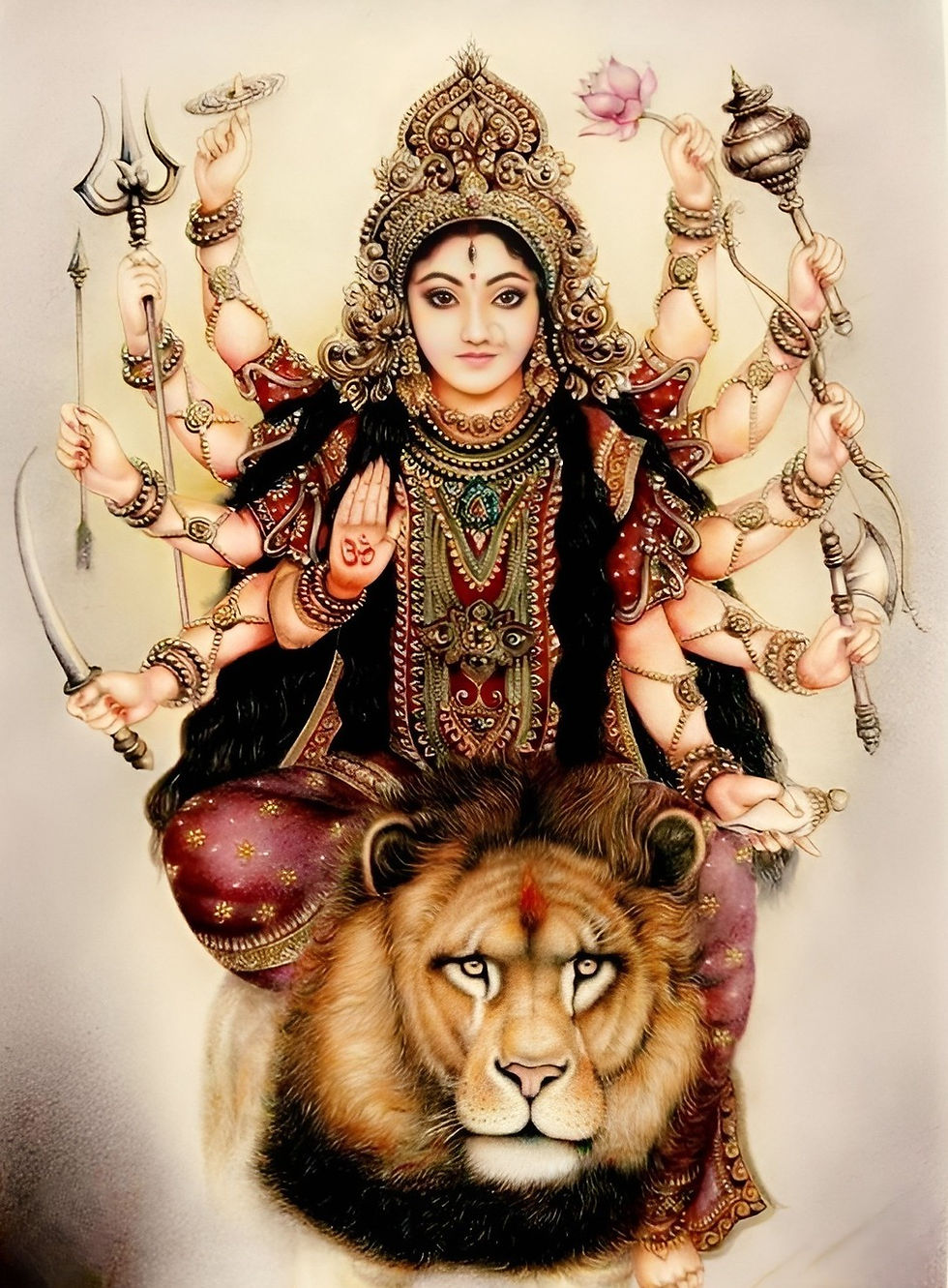
Goddess Durga is one of the most revered deities in the Hindu tradition, honored as the embodiment of Sacred Feminine Energy. She represents strength, protection, balance, and the transformative force that arises whenever harmony is disturbed. Durga is understood as Chit‑Shakti, the conscious power from which matter, life, and mind emerge. Her familiar iconography—riding a lion or tiger and holding weapons in multiple hands—symbolizes the rise of cosmic force to restore order and safeguard creation.
The name “Durga,” derived from the Sanskrit drug, meaning “fortress” or “that which is difficult to cross,” reflects her invincible nature. She is the guardian who protects the cosmos from forces that disrupt its equilibrium. While she confronts destructive energies, she is equally revered as a nurturing presence who upholds stability with unwavering care.

Mythological Foundation
The most widely known story of Durga’s power is her battle with Mahishasura, the demon capable of taking many forms, who represents ego, ignorance, and unrestrained force. His multiple forms symbolize the subtle and persistent nature of imbalance. When the gods were unable to subdue him, they combined their energies to manifest Durga, a radiant being endowed with cosmic weapons and perfect clarity. This account, preserved in the Devi Mahatmya, describes how she confronted Mahishasura for nine nights and restored balance on the tenth day—an event grandly celebrated across India during the festival of Navaratri and at Durga Puja. The spirit of this victory is also praised in Adi Shankara’s Mahishasura Mardini Stotra, a hymn recited throughout Navaratri to honor her courage, grace, and protective power.
The Devi Mahatmya, composed in the 5th century CE, reveals Durga’s supreme power and her role in restoring balance to the cosmos. It recounts her battles against forces that disturb the harmony between the cosmos, the natural world, and human life. The demons she confronts are portrayed as distorted inner qualities—arrogance, greed, anger, hypocrisy, and injustice—revealing how they mirror the afflicted ego and the many ways the mind attempts to trick, deceive, or even attack ourselves and others, showing that her victories are as much about overcoming inner limitations as defeating outer forces. Through these narratives, the Devi Mahatmya teaches that the radiance of truth and wisdom ultimately dispels disorder and suffering.
Symbolism and Deeper Meaning
Durga’s form conveys layered spiritual meaning. Her many arms represent complete capability and vigilance. The lion or tiger beneath her signifies mastery over fear and instinct. Each weapon she carries is a spiritual tool: the sword that cuts through illusion, the bell that dispels confusion, the shield that protects against hostility, the club that subdues judgment and over‑analysis, and the spear that pierces to the heart of truth. Her calm expression amidst dynamic action reflects disciplined strength—power guided by clarity rather than impulse.
Philosophically, Durga is understood as Śakti, the dynamic energy that animates existence; as Prakṛti, the creative principle through which the universe evolves; and as cosmic intelligence, the awareness that directs energy toward harmony and transformation. She is also recognized as the unifying essence behind many goddesses.
Kali expresses her fierce transformative aspect, Parvati her nurturing dimension, and forms such as Ambika, Mahalakshmi, Chandika, and the Navadurga—the nine manifestations honored during Navaratri—reveal further facets of her cosmic work.

Durga: Universal Sovereign and Dual Nature
Durga is also known as Adhya, the primordial Mother and consort of Lord Brahm, regarded as the mother of Brahma, Vishnu, and Shiva. She is honored as the foremost expression of Devi, encompassing both creative and governing authority. While central to Shaktism, she is also revered in Shaivism, Vaishnavism, Jainism, Buddhism, and the Sikh tradition, where the Dasam Granth praises her as a divine manifestation of courage.
In tantric traditions, she is described as possessing eight to eighteen arms and sixty‑four arts, symbolizing her mastery over all aspects of existence. In her Durga form, she remains independent of any male deity, embodying both protective and formidable qualities.
Within the Brahmanda—the cosmic realm governed by cosmic principles—souls come into manifestation through Durga, who carries the seed‑gift of Sat Purush, the supreme source of all souls. She oversees their maturation through experience, allowing them to ascend to higher realms only when they have developed sufficient clarity and strength. Spiritual progression involves gradually transcending the creation governed by Lord Brahm and Durga, rising toward subtler planes through inner development, patience, and spiritual discipline.
Maya, or cosmic illusion, is integral to her function. As the Cosmic Mother, she both conceals and reveals the soul’s origin. These veils—formed by conditioning, duality, and limitation—are part of the cosmic design rather than errors. Maya represents Durga’s concealing aspect, while her nurturing nature guides the soul toward the higher region attainable within the Brahmanda, often called BrahmaJyoti.
In Vaishnava narratives, she appears as Yogamaya, the power that orchestrates events through intelligent concealment. Here, illusion is not deceptive but purposeful, allowing divine intentions to unfold within the world. As the sister of Lord Krishna—exchanged at birth to protect him from Kamsa—Yogamaya embodies the cosmic intelligence that arranges cosmic events with precision. Through this dual capacity—to veil and to guide—Durga becomes a force of coordination, transition, and cosmic balance.

Durga represents the organizing and corrective force of the universe. She is the power that arises when an imbalance appears, acting with discernment rather than impulse. Within the Brahmanda, she governs creation, limitation, and liberation, sustaining souls while binding them to cosmic law until they are ready to transcend it.
Durga is felt within as the Shakti that strengthens the heart, sharpens clarity, and sustains resilience. She protects dharma, ensuring that life moves toward truth, justice, and compassionate action. As the intelligence of nature, she is present in the balance of the elements and the vitality that supports all living things. Durga is the Great Mother who helps us remove the limitations and the emotional and mental obscurations that prevent us from shining the spiritual light within. Durga stands as both inner strength and outer harmony, completing the circle of her presence—from the vastness of the cosmos to the depth of the human spirit.
Sources:
FAIR USE NOTICE: This site may contain copyrighted material, the use of which has not
always been specifically authorized by the copyright owner. Such material is made available to advance understanding of ecological, political, human rights, economic, democracy, scientific, moral, ethical, and social justice issues, etc. It is believed that this constitutes a 'fair use' of any such copyrighted material as provided for in section 107 of the US Copyright Law. In accordance with Title 17 U.S.C. Section 107, this material is distributed without profit to those who have expressed a prior general interest in receiving similar information for research and educational purposes. For more information, go to: http://www.law.cornell.edu/uscode/17/107.shtml
If you are the copyright owner and believe that this article infringes your copyright, and you would like us to remove this article, please contact us here and we will review your request.


Comments